Oxford & Loom may earn a commission or have a financial relationship with brands featured on this site, including brands under common ownership. See our Advertising Disclosure.
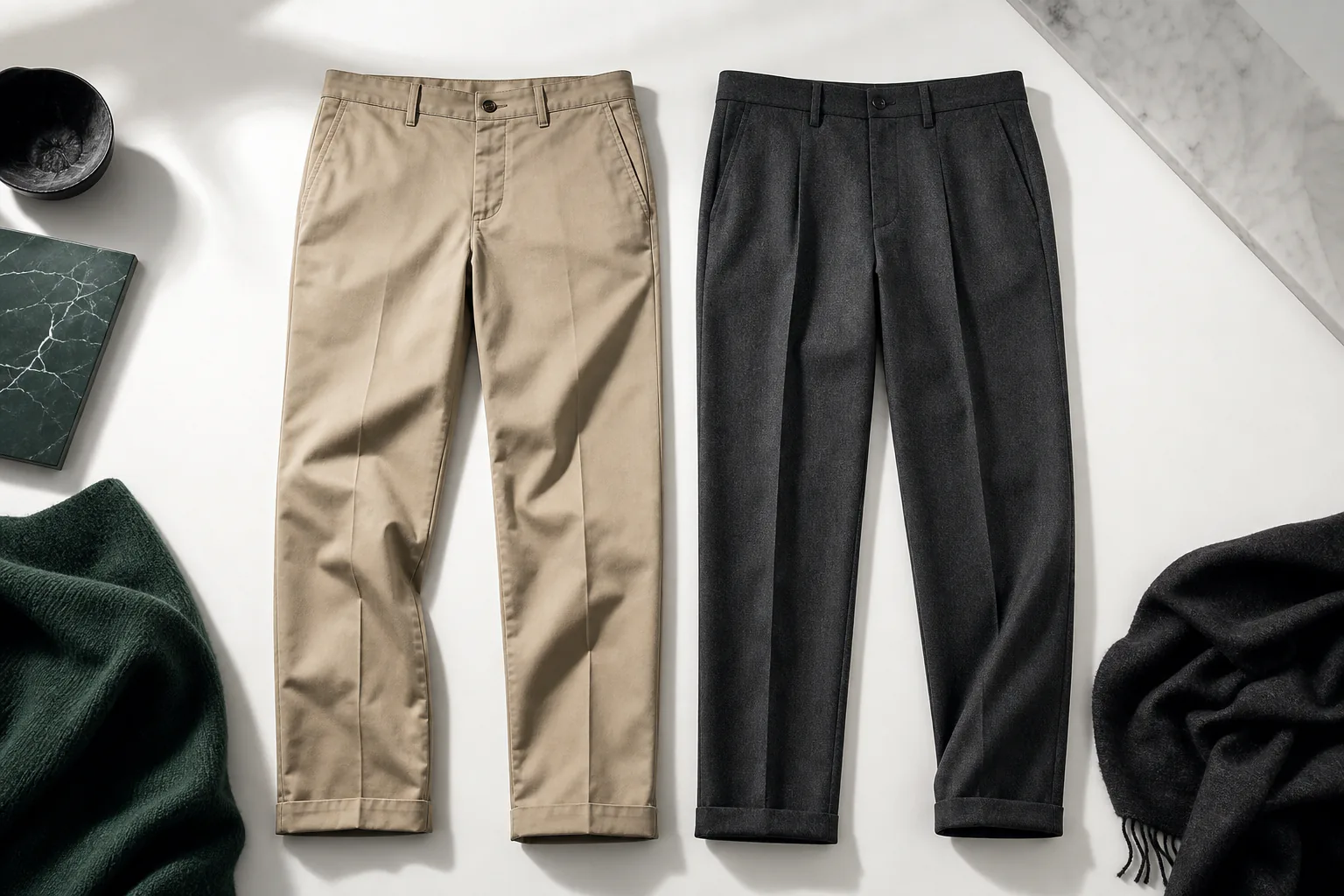
Chinos and dress pants look close enough on a hanger that a lot of men treat them as interchangeable. They aren't. One is a cotton twill built for everyday wear; the other is a tailored garment built to hold a crease and sit under a jacket. Wear the wrong one to the wrong thing and it shows immediately, even if the reason isn't obvious at first glance.
The difference comes down to fabric, construction, and the occasions each was designed to solve. Once you can spot those, choosing between them stops being a guess.
Fabric is the fastest tell
Chinos are cotton twill: a diagonal weave that gives the fabric a soft hand and some visible texture. Dress pants are usually wool, wool-blend, or a fine synthetic blend, woven to hold its shape and drape cleanly from the waist. Cotton wrinkles and softens with wear; wool resists both, which is part of why dress pants look sharp through a long day at a desk or in meetings.
Weight matters too. Chinos in a mid-weight cotton work across three seasons; dress pants in a lighter wool suit warmer months, while a heavier flannel wool suits winter. Buying one weight for each and rotating by season solves most of the "what do I wear today" problem before it starts.
Construction signals the occasion
Dress pants are cut with a cleaner line, often a slight taper, and finished with details like a fuller waistband, sometimes side tabs or a lower-profile pocket. Chinos tend to have a more relaxed cut through the seat and thigh, patch or slanted pockets, and a more casual waistband, with belt loops sized for a casual belt rather than a fine dress belt.
Those construction choices aren't decorative. A dress pant's cleaner silhouette is what lets it disappear under a jacket without adding bulk. A chino's roomier cut is what makes it comfortable enough to wear all day without a jacket at all.
Where each one actually belongs
Chinos work for:
- Casual Fridays and most business-casual offices
- Weekend errands, paired with a t-shirt or an oxford shirt
- Travel days, where a wrinkle-resistant cotton blend beats wool
Dress pants work for:
- Interviews, client meetings, and anything with a suit-adjacent dress code
- Occasions where you're wearing a blazer or sport coat and want the trouser to match its formality
- Evening events where cotton twill would read too casual next to a proper pair of dress shoes
The overlap sits in business casual, where a well-cut chino in a dark color and a lightweight wool trouser can both work. The deciding factor is usually what's happening above the waist. A blazer tips it toward dress pants; a knit polo or oxford shirt tips it toward chinos.
How to tell at a glance, even in a store
If you're standing in front of a rack and can't remember which category a pair belongs to, a few quick checks settle it. Rub the fabric between two fingers: cotton feels slightly textured and matte, wool feels smoother and often has a faint sheen depending on the weave. Check the lining. Dress pants are usually lined at least partway down the leg or through the seat, while chinos rarely have any lining at all. And look at the closure: dress pants more often use a hook-and-bar or extended waistband tab, while chinos typically stick with a simple button.
A quick decision guide
When you're not sure which to reach for, run through this in order:
- Blazer or suit jacket involved: dress pants.
- Outdoor setting, or standing and moving for hours: chinos.
- Business casual with no jacket expected: either works. Let the shirt and shoes decide.
- Traveling and want a pair that resists wrinkling in a bag: chinos, almost always.
Getting the fit right on both
Regardless of fabric, the fit rules are largely the same. The waistband should sit at your natural waist without gapping. The break at the ankle should be minimal: a slight fold at most, not pooling. And the rise should match your torso, not just whatever the size chart defaults to.
Color plays a role in versatility too. Neutral chinos in khaki, olive, or navy pair with almost anything. Dress pants in charcoal or navy do the same job for more formal wardrobes, and both colors work well with the leather rules we lay out in how to match belts and shoes.
Buying one of each before buying more
If you own neither, resist the urge to buy several colors of one and skip the other entirely. A single pair of well-fitted navy or charcoal dress pants and a single pair of khaki or olive chinos will cover more situations than five pairs of one type ever will. Add a second color once you know which one you reach for more often. Most men outside formal office jobs end up buying their second and third chino before their second dress pant. Our pants and denim coverage runs through what's worth adding after that.
Bottom Line
Chinos are the everyday pant: cotton, relaxed, forgiving. Dress pants are the formal pant: wool, tailored, built to disappear under a jacket. Own a good pair of each in a neutral color and the "what do these go with" question mostly answers itself.