Oxford & Loom may earn a commission or have a financial relationship with brands featured on this site, including brands under common ownership. See our Advertising Disclosure.
Belts and shoes do not need to be the same shade of brown to work together. They need a matching tone and a matching finish, and both are things you can check in the time it takes to tie your shoes.
The rule itself
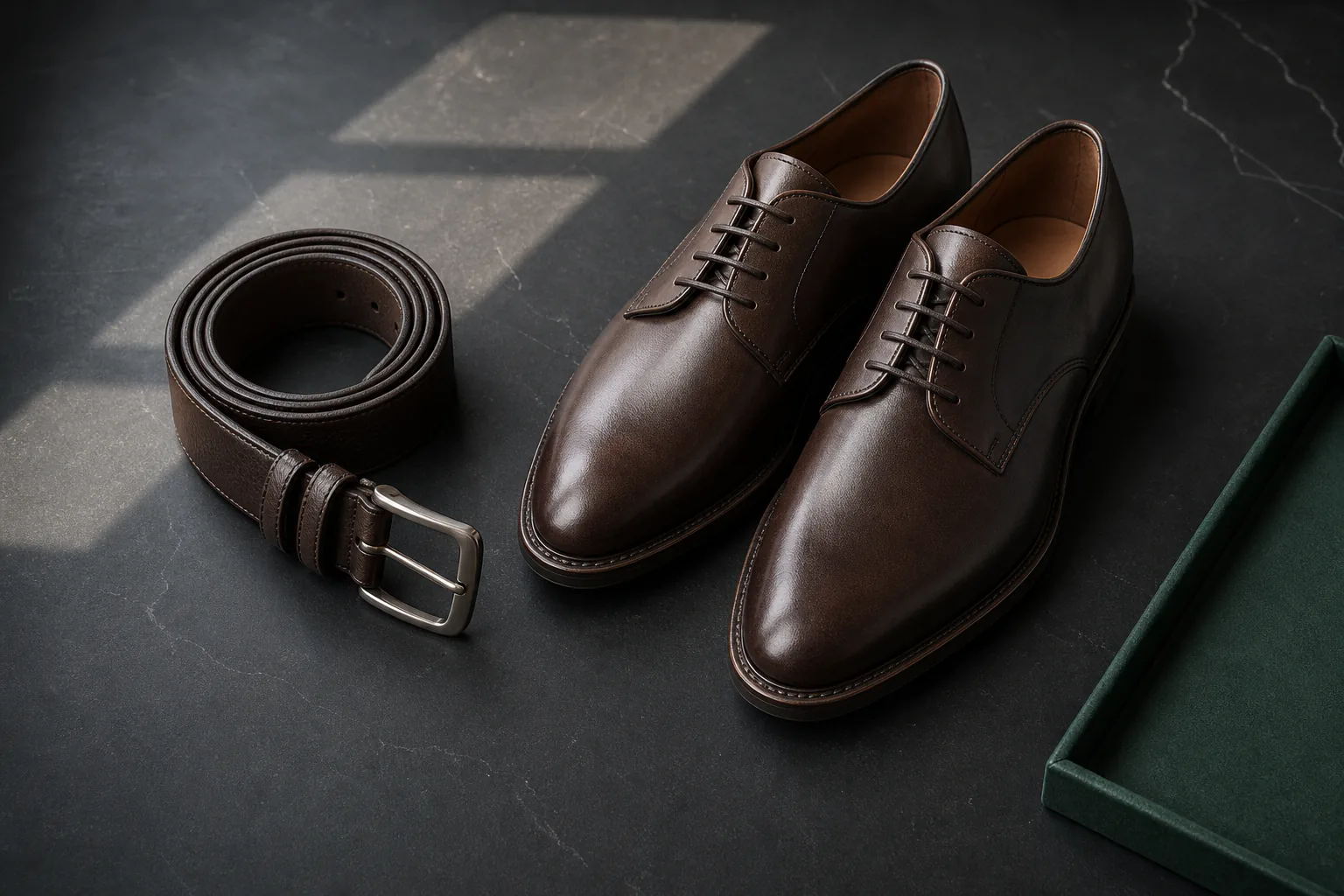
Two variables decide whether leathers look coordinated: warmth and shine. Warm leathers pair with warm leathers. Cool leathers pair with cool leathers. Matte goes with matte, and polished goes with polished. Get those two things right and the exact shade stops mattering nearly as much as most style advice implies.
This is the same logic that governs a good chinos vs. dress pants decision: the details that actually register with other people are rarely the ones that get the most attention in men's style forums.
Warm browns stay together, cool browns stay together
Most brown leather falls into one of two families:
- Warm brown: chestnut, cognac, tan, and other shades with a reddish or orange cast.
- Cool brown: dark walnut, chocolate, and espresso tones that lean gray or neutral.
A cognac belt with dark walnut shoes will read as mismatched even though both are technically brown, because the undertones fight each other. Swap in a mid-brown belt with a similar reddish cast and the same shoes suddenly look deliberate. If you're building or narrowing down a shoe rotation, our guide to how dress shoes should fit is worth reading alongside this one, since fit problems tend to draw more attention than a slightly off leather tone ever will.
Match the finish before you match the color
Finish does more visual work than color. A smooth, polished calfskin belt next to a pair of matte suede shoes looks off no matter how close the shades are, because one surface catches light and the other absorbs it. Pair polished with polished and suede or matte with suede or matte, and the outfit reads as a set even if the exact browns are two or three shades apart.
This is also why a black patent belt rarely works with anything but the shiniest black oxfords. Most black leather goods in a normal wardrobe are matte or lightly polished, so patent stands out as the odd one rather than the sharp one.
Metal hardware counts too
Buckles, eyelets, and any exposed hardware on a belt should match the metal tone of your watch, and ideally your shoe buckles if you're wearing loafers with a bit. Silver-tone hardware with gold-tone elsewhere is a small detail, but it's one of the few leather-matching mistakes people notice without being able to say why.
The fix is simple once you know to look for it. Lay your watch, belt buckle, and any shoe hardware on a table before you get dressed. If two of the three don't match, swap one out. Most men own enough belts and watches that the swap costs nothing beyond the thirty seconds it takes to check.
What about wallets and bags
The same tone-and-finish logic extends to wallets, card cases, and any bag you're carrying, though the rules loosen slightly the farther an item sits from your feet. A wallet lives in a pocket most of the day, so a shade of brown that's slightly off from your shoes is rarely noticed. A bag you're carrying at hip height is more visible, and it's worth treating with the same care as a belt.
If you only own one or two bags, buy them in a cool brown or black. Those two tones sit closest to neutral and will cross over with the widest range of belts and shoes you're likely to own over time. The same tone-and-finish logic runs through the rest of our accessories coverage, not just belts and bags.
Where the rule gets looser
Black and brown do not need to match each other at all, since they're different categories rather than different shades of the same one. A black belt with brown shoes, or the reverse, works fine as long as you're not also trying to match a bag or a watch strap into the mix. The rule only applies within a color family: browns to browns, blacks to blacks.
Casual leather is more forgiving than dress leather. A weekend outfit built around penny loafers, which we cover in full in the loafer guide, can carry more contrast than a suit does, because texture and wear patterns are doing some of the coordinating work that tone usually handles on smoother dress leather.
Suede is its own category and mixes with almost anything matte, including canvas belts and unlined casual shoes. Because suede has no shine to clash with, it sidesteps most of the finish problems that trip up smooth leather.
A quick check before you leave
Run through this in the time it takes to grab your keys:
- Belt and shoes both warm brown, or both cool brown, or both black.
- Belt and shoes both matte, or both polished, not one of each.
- Watch, belt buckle, and shoe hardware all in the same metal tone.
- Bag, if you're carrying one, close enough in tone that it doesn't fight the belt.
If all four line up, the outfit is done. Anything closer than that is a matter of personal taste rather than a rule worth losing sleep over.
Bottom Line
Check two things before you leave: does the belt's undertone match your shoes, and does the finish match too. Everything past that, including the exact shade, is a rounding error most people won't clock. Spend the sixty seconds on tone and finish, and the rest of the outfit will take care of itself.