Oxford & Loom may earn a commission or have a financial relationship with brands featured on this site, including brands under common ownership. See our Advertising Disclosure.
A loafer is the shoe that gets a man dressed faster than anything else in his closet, no laces, no tying, on and off in one motion. But "loafer" isn't one shoe: penny, tassel, and horsebit versions carry different amounts of formality, and treating them as interchangeable is how a good pair ends up worn to the wrong event.
Here's what separates the three, and where each one actually belongs.
The penny loafer
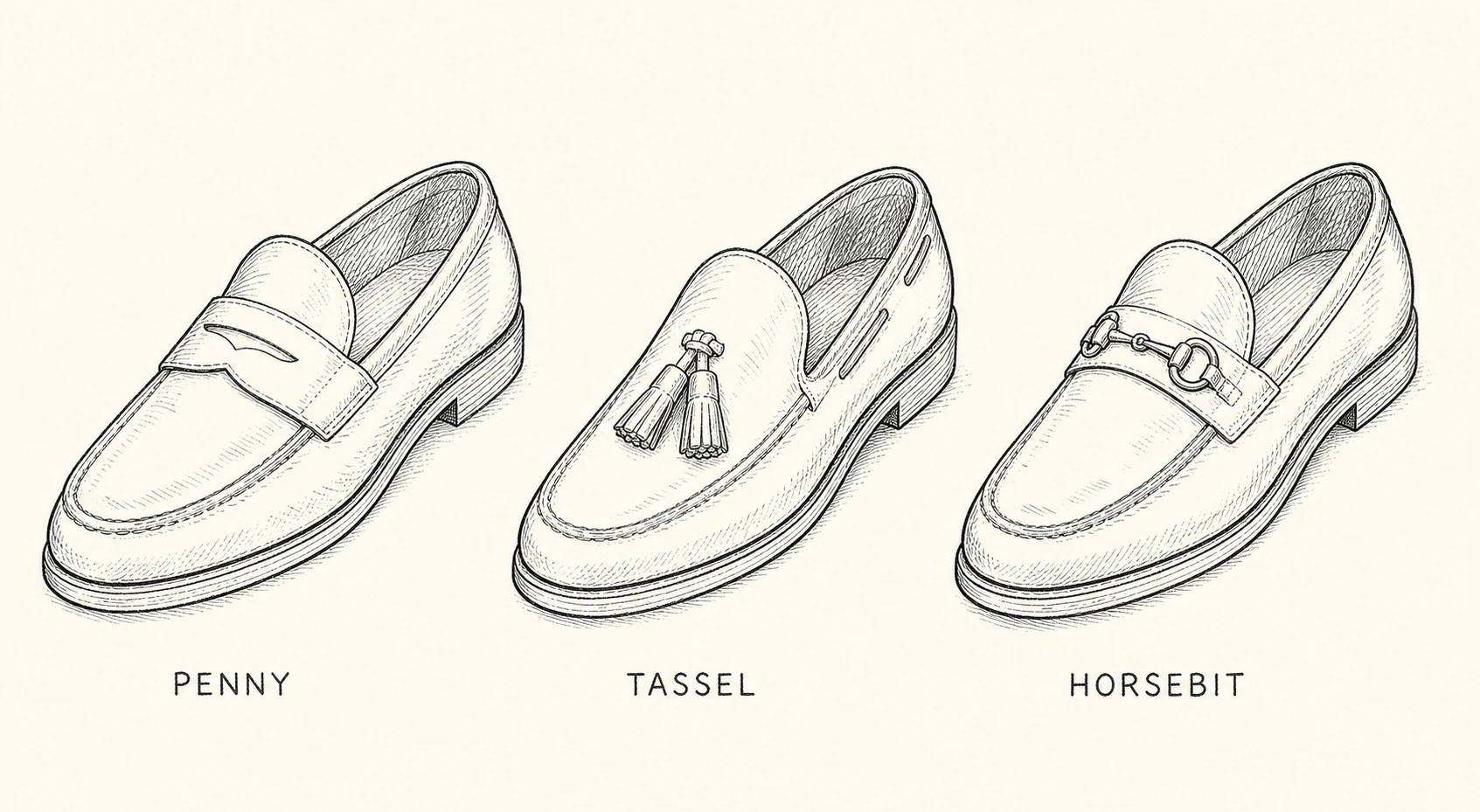
The penny loafer is the most casual and most versatile of the three. Its defining feature is the strap across the vamp with a diamond-shaped cutout, originally meant to hold an actual penny, though almost nobody uses it that way now. The silhouette is clean and low-profile, with minimal hardware.
That simplicity is what makes it work across the widest range of outfits. A penny loafer in brown or burgundy pairs easily with chinos, dark denim, or lightweight wool trousers. It's the loafer to reach for on a casual Friday, a weekend dinner, or any business-casual office that allows it. It reads dressier than a sneaker but more relaxed than a cap-toe oxford.
The tassel loafer
The tassel loafer adds two small tassels at the front, connected to leather laces that wrap around the vamp, decorative, not functional. That detail nudges the shoe toward a more traditional, slightly preppy register. It shows up often in American menswear associated with law offices, universities, and old-money dressing, though it's loosened up considerably in recent years.
A tassel loafer works well with tailored trousers and a blazer, or with a suit in a more relaxed office that allows loafers over lace-ups. It's a step dressier than a penny loafer thanks to the extra detailing, but it's still a loafer. It won't read as formal as a proper oxford shoe, and shouldn't be worn expecting it to.
The horsebit loafer
The horsebit loafer takes its name from the metal hardware across the vamp, shaped like a snaffle bit from horse tack, most associated with Gucci, which popularized the style, though plenty of other makers now produce their own versions. It's the most overtly dressed-up of the three, thanks to the metal hardware doing a lot of visual work.
That hardware also makes it the least neutral option. A horsebit loafer draws attention in a way a penny or tassel loafer doesn't, so it pairs best with an outfit that isn't competing for the same attention elsewhere: clean trousers, a simple shirt, nothing else with heavy hardware or logos.
Choosing between them
- Building your first pair: start with a penny loafer in brown. It works with the most outfits and the widest range of dress codes.
- Adding a second pair for the office: a tassel loafer in black or oxblood covers dressier days without going full lace-up.
- Want something with more presence: a horsebit loafer, worn with an otherwise simple outfit, adds detail without adding formality.
Signs of quality worth checking before you buy
Not all loafers in a given style are built the same way, and a few details separate a pair that lasts from one that doesn't. Check the sole construction first: a stitched or Blake-stitched sole can typically be resoled, while a fully cemented sole usually can't, which limits the shoe's lifespan. Look at the leather itself under good light: full-grain leather develops a better patina over years of wear, while heavily corrected or coated leather tends to crack rather than age. And check the vamp strap or hardware on tassel and horsebit versions; stitching that's already loose in the store will only get worse. These same checks apply across most of our shoes coverage, not just loafers.
Fit and sizing
Loafers have no laces to adjust for fit, so getting the size right matters even more than it does with lace-up dress shoes. A loafer that's too big will slip at the heel with every step; too small, and there's no way to loosen it. Try loafers on with the socks you'll actually wear them with, and expect the fit to feel snug through the instep on day one. Quality leather loafers relax slightly with wear, but they shouldn't need to stretch dramatically to feel right.
Sockless wear is common with loafers in warm weather, but it changes the fit calculation slightly since there's no sock layer buffering the leather. If you go sockless regularly, size according to how the shoe fits without socks, not with them.
What to wear them with
All three loafer styles pair well with chinos, lightweight wool trousers, and tailored shorts in warm weather. Penny loafers extend to dark denim; horsebit and tassel loafers generally look better kept to trousers rather than casual denim, given their dressier detailing. On the sock question specifically, matching your leathers and choosing the right socks for the shoe both matter more with loafers than with sneakers, since there's less fabric elsewhere to distract from a mismatch.
Suede is worth considering too, especially in a penny loafer. A suede pair reads slightly more casual than the same shoe in polished calfskin, which makes it a sensible second pair once you already own one in leather, and it carries well through fall and winter when the ground stays dry. It needs different upkeep than calfskin: a soft brush to lift dirt and restore the nap, and a water-repellent spray applied before the first wear, since suede stains more easily than leather and can't be wiped clean once it does.
Bottom Line
Penny, tassel, and horsebit loafers sit at three different points on the formality scale, from most casual to most detailed. Knowing which is which, and matching that to the dress code in front of you, is the entire skill. The shoes themselves just need to fit well and be kept in good condition. Buy a new pair before you need it for an event, not the week of, so the leather has a chance to settle before a full day on your feet.