Oxford & Loom may earn a commission or have a financial relationship with brands featured on this site, including brands under common ownership. See our Advertising Disclosure.
A thin dress sock under running shoes will bunch, slide, and blister you by mile two. A cushioned athletic sock under a suit will pool at the ankle and print a ridge through your trouser leg. Same category of garment, two different jobs, and treating them as one has cost most men a drawer full of socks that don't work for anything.
What actually separates the two
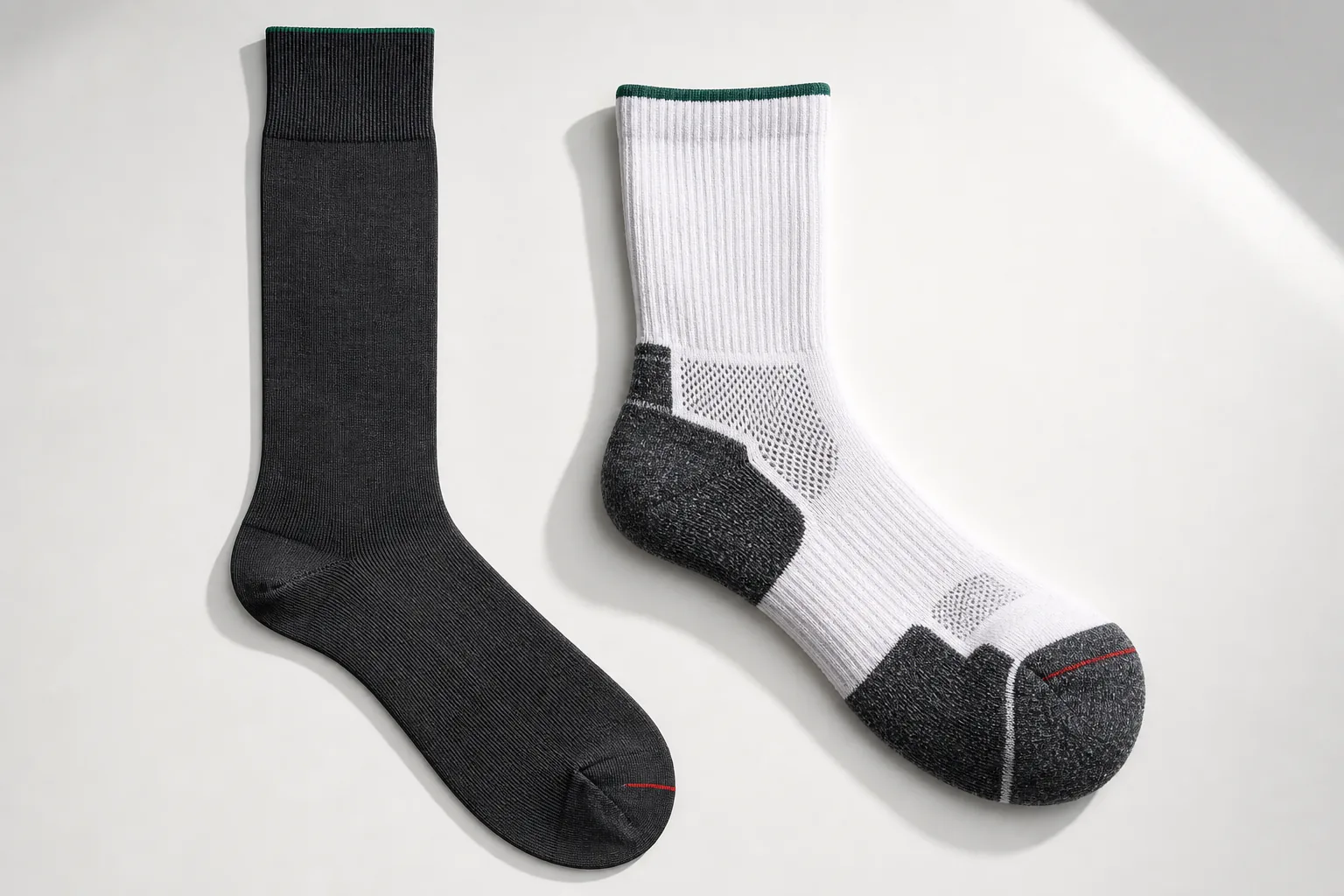
Dress socks are built to disappear. They're cut thin, usually in a fine-gauge cotton lisle, merino, or a wool blend, so the leg holds its line under a trouser cuff without adding bulk. There's little to no cushioning, since the goal is a clean silhouette between shoe and hem, not shock absorption.
Athletic socks are built to work. They're knitted denser, often with mesh zones for airflow, targeted cushioning at the heel and ball of the foot, and enough compression to keep the sock from migrating inside a shoe during lateral movement. Some of that engineering carries over into casual life, which is exactly why it doesn't belong under a blazer.
Fit and length rules that follow the shoe
Sock length should track the trouser break, not the season. With dress trousers, an over-the-calf or mid-calf sock keeps skin from showing when you sit down and cross a leg, still the most common way a good outfit gets undone. With sneakers or gym shoes, a no-show or low-cut cut keeps the sock invisible and out of the way of the shoe's own ankle collar.
We cover the shoe-by-shoe version of this in what socks to wear with loafers and sneakers, but the short version: let the shoe decide the cut, and let the occasion decide the fabric.
Fabric matters more than most men think
A dress sock in the wrong fiber looks fine for an hour and then starts to sag. Fine cotton lisle has a slight sheen and holds shape well for half a day; merino wool breathes better across a full one and resists odor longer, which matters if you're on your feet all day in leather shoes. We get into the broader comparison in merino wool vs. cotton, but for socks specifically, merino earns its higher price if you wear dress shoes more than two or three days a week.
Athletic socks lean synthetic on purpose: nylon and spandex for stretch retention, polyester or merino blends for moisture management. That's not a shortcut; it's the correct material for a sock that has to survive repeated washing and hard lateral movement without losing its shape.
Sock height, explained
Height causes as much confusion as fabric. Four cuts cover nearly every situation:
- No-show: sits below the ankle bone, hidden inside a loafer or low sneaker. Never appropriate with tailored trousers, where a bare ankle reads as undone rather than intentional.
- Quarter or ankle: covers the ankle bone, the standard choice for casual sneakers and everyday errands.
- Crew: mid-calf, the workhorse length for athletic wear and casual pants alike.
- Over-the-calf: extends just below the knee and is the only correct length for dress trousers, since it stays put when you sit down and cross a leg.
Get the height wrong and even the correct fabric won't save the outfit. A no-show sock under dress trousers exposes skin the moment you sit, and a crew-length athletic sock under a suit prints a visible line through the fabric.
How many of each you actually need
Most closets are overloaded with one category and short on the other. A workable split for a man who dresses up two or three days a week: seven to eight pairs of over-the-calf dress socks in navy, charcoal, and black, plus six to eight pairs of athletic or casual crew socks for the gym and weekends. Buying more colors than that mostly creates a matching problem without adding real function. Socks are one of the easiest items in our accessories lineup to get right once you know the split you actually need.
Where the two categories overlap
Casual socks worn with white sneakers or clean trainers sit in the middle: heavier than a dress sock, lighter than a true athletic sock, usually a cotton-poly blend with a bit of stretch. That's the pair you want for a weekend outfit built around white sneakers: enough structure to hold up, none of the visible cushioning that reads as "gym sock" with jeans.
A few signs your current sock drawer is miscategorized:
- Your "dress" socks have visible ribbing or a cushioned footbed.
- You're wearing ankle-length athletic socks with tailored trousers.
- Every sock in the drawer is the same weight, regardless of what shoe it's paired with.
If any of that sounds familiar, the fix is buying the right two or three categories and retiring everything that doesn't fit one, not simply buying more socks. If you're ready to upgrade past a drawer of mismatched basics, we put one everyday option through a two-week wear test to see how it held up across both dress shoes and sneakers.
Caring for each type
Dress socks in merino or fine cotton last longer with cooler water and air drying; high heat breaks down the elastic in the cuff faster than the wear itself does. Athletic socks can generally handle warmer washes since the synthetic fibers are built for it, but a dryer sheet or fabric softener will coat the moisture-wicking fibers and reduce the exact performance you bought them for. Wash athletic socks with a plain detergent, no softener, and they'll hold their function well past when a treated pair would have stopped breathing properly.
Turn both types inside out before washing. It cuts down on pilling from friction against other clothes and keeps the outer surface, the part everyone actually sees, looking newer for longer.
Bottom Line
Keep dress socks thin, over-the-calf, and matched to trouser color. Keep athletic socks cushioned, moisture-managing, and cut to the shoe's collar. The two should never be interchangeable, and once you stop asking one pair to do both jobs, both jobs get easier.