Oxford & Loom may earn a commission or have a financial relationship with brands featured on this site, including brands under common ownership. See our Advertising Disclosure.
Buy one good oxford shirt and you can skip the next five purchases you were about to make. It goes under a sweater, under a blazer, alone with jeans, tucked into chinos for the office. Nothing else in a standard rotation covers that much ground without looking like it's trying to cover that much ground.
That versatility comes from the fabric itself, the collar construction, and a fit that splits the difference between dress shirt and casual shirt. Here's what actually makes an oxford worth owning, and how to pick one that earns a permanent spot in the rotation.
What makes it an oxford, specifically
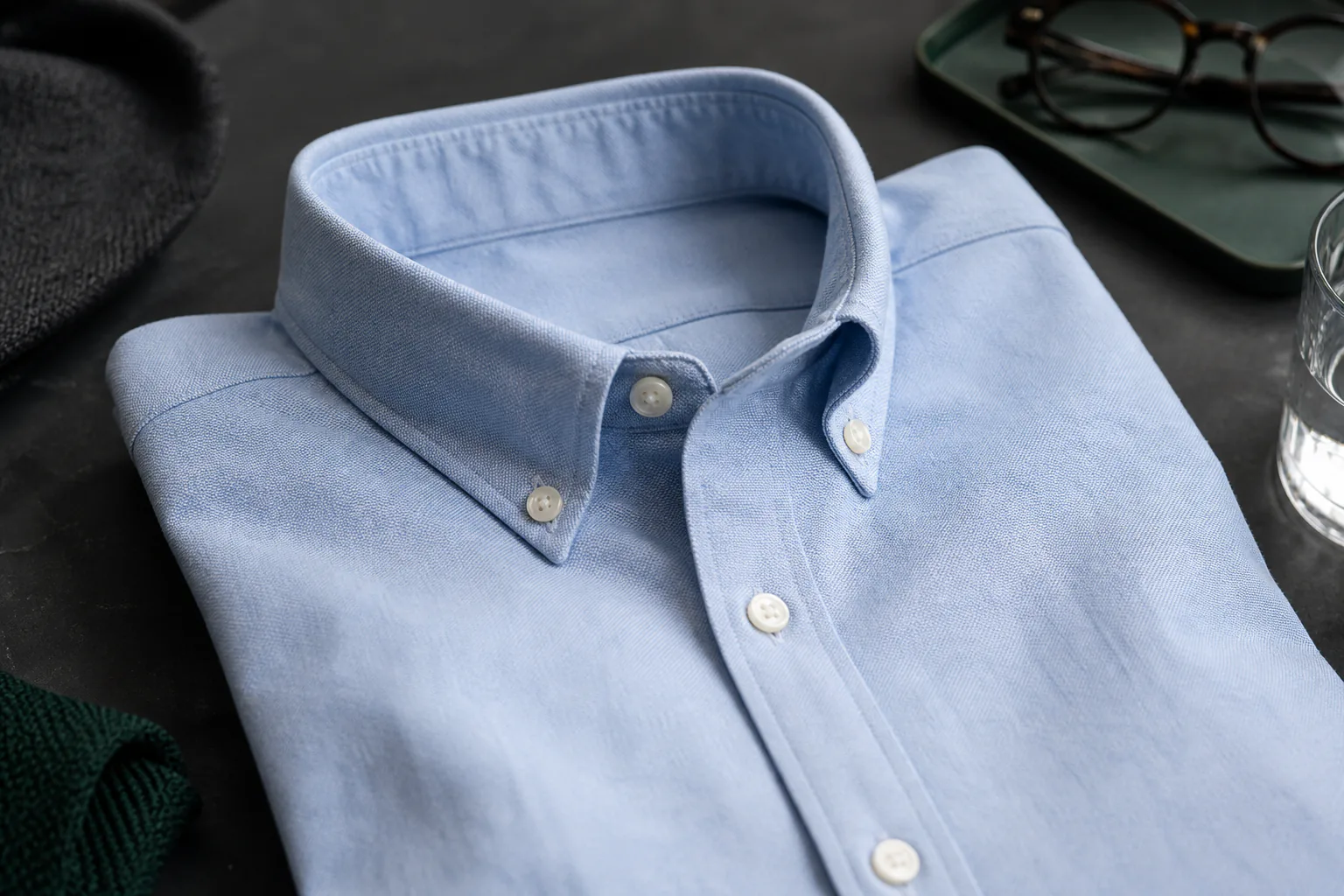
Oxford cloth is a basketweave: two threads woven as one, crossed with a single heavier thread, which gives the fabric its slightly nubby texture and matte finish. That weave is why an oxford shirt looks substantial in a way that broadcloth or poplin doesn't. It also explains the durability. A quality oxford softens with washing instead of thinning out.
Three weights show up most often:
- Pinpoint oxford: finer yarns, smoother finish, closer to a dress shirt. Good under a jacket.
- Standard oxford: the classic button-down, visible texture, the most versatile weight.
- Royal oxford: denser and slightly shinier, dressier than the standard weave but still casual enough for no tie.
The collar decides how it reads
Button-down collars are the defining trait of the traditional oxford shirt, and they matter more than color or fit. The buttons keep the collar anchored so it doesn't flip up in wind or under a sweater, which is exactly why the style works alone, with no tie and no blazer. A spread or point collar on the same fabric reads more like a dress shirt and loses some of that easy, thrown-on quality.
If you're building toward a wardrobe where every piece does double duty, the button-down oxford is close to non-negotiable. We cover the surrounding logic, what to keep and what to cut, in our capsule wardrobe guide.
Fit matters more than fabric
An oxford that's too full through the body looks like a uniform shirt. Too slim, and the button-down collar can't sit flat because there's no room in the chest to let it lie naturally. Look for:
- Shoulder seams that land at the edge of your shoulder, not partway down your arm
- Enough room through the chest to sit down and reach forward without pulling
- A hem long enough to stay tucked, or a straight hem if you plan to wear it untucked
- Sleeves that end at the wrist bone, not mid-hand
Most ready-to-wear oxfords run generous through the body to accommodate a range of builds, so trying before you buy, or checking a brand's actual measurements against your own, saves a return.
Color and pattern, in order of usefulness
White and light blue cover the most ground and should be the first two colors in a rotation. Both work equally well tucked or untucked, under a sweater or alone, and neither reads as too formal or too casual for the range of settings an oxford ends up in.
After those two, a few options extend the shirt without adding much risk:
- Pink or ecru: softer than white, still neutral enough to pair with most trousers.
- Narrow stripes: university stripe or a fine bengal stripe reads slightly more casual than a solid, useful for weekends.
- Chambray-adjacent blues: a heavier, deeper blue oxford leans workwear and pairs well with the raw denim we cover separately.
Bold patterns and heavy plaids move an oxford away from its core job, which is being the shirt you don't have to think about. They're fine as an occasional addition, but they shouldn't be the first two or three shirts you buy.
Where it actually goes in a week
A white or light blue oxford covers office days when the dress code sits somewhere between casual and business casual: sleeves rolled with chinos on a Wednesday, buttoned to the top under a crewneck sweater when the building runs cold, layered under a quarter-zip once the weather turns and it's time to think about layering for fall. On weekends, the same shirt works untucked with jeans, sleeves pushed up, no undershirt needed given how much body the fabric already has.
That range is the entire argument for owning more than one. A white oxford and a blue oxford in the same cut cover most situations a given week throws at you, with almost no thinking required each morning. It's the kind of foundational piece worth building the rest of your shirts and tops rotation around.
Care that keeps it looking right
Oxford cloth holds up to regular washing better than thinner dress shirt fabrics, but a few habits extend its life. Wash cold, skip the dryer's high heat setting, and iron while still slightly damp if you want a crisp finish. The fabric's texture forgives some wrinkling, so a lower-effort press is usually enough. Button-down collars should stay buttoned in the wash so they don't curl.
What separates a good oxford from a mediocre one
Price alone doesn't guarantee quality, but a few construction details do. Check the collar for a removable or permanent interlining that keeps its shape after washing. A floppy collar after one wash usually means the interlining is too light. Look at the buttons: mother-of-pearl or a dense polyester holds up better than thin plastic. And check the side seams; a shirt with a split hem and reinforced side seams will handle tucking and untucking without fraying at the sides.
None of these details show up in a product photo. They show up after ten washes, which is exactly when a cheap shirt starts to look tired and a well-made one starts to look better, as the fabric softens without losing shape.
Bottom Line
An oxford shirt splits the difference between dressy and casual, built to work in both directions at once. Buy one in a standard weight with a button-down collar, get the fit right through the shoulders and chest, and it will outlast and outwork most of what else is hanging in the closet.