Oxford & Loom may earn a commission or have a financial relationship with brands featured on this site, including brands under common ownership. See our Advertising Disclosure.
Outerwear and shoes get replaced on a visible schedule: you can see the wear. Basics fail quietly. The elastic goes soft, the fabric thins, and you keep wearing them anyway because nothing looks obviously broken. Here's how long each category actually lasts and what to look for instead of guessing.
Socks: 6 to 12 months of regular rotation
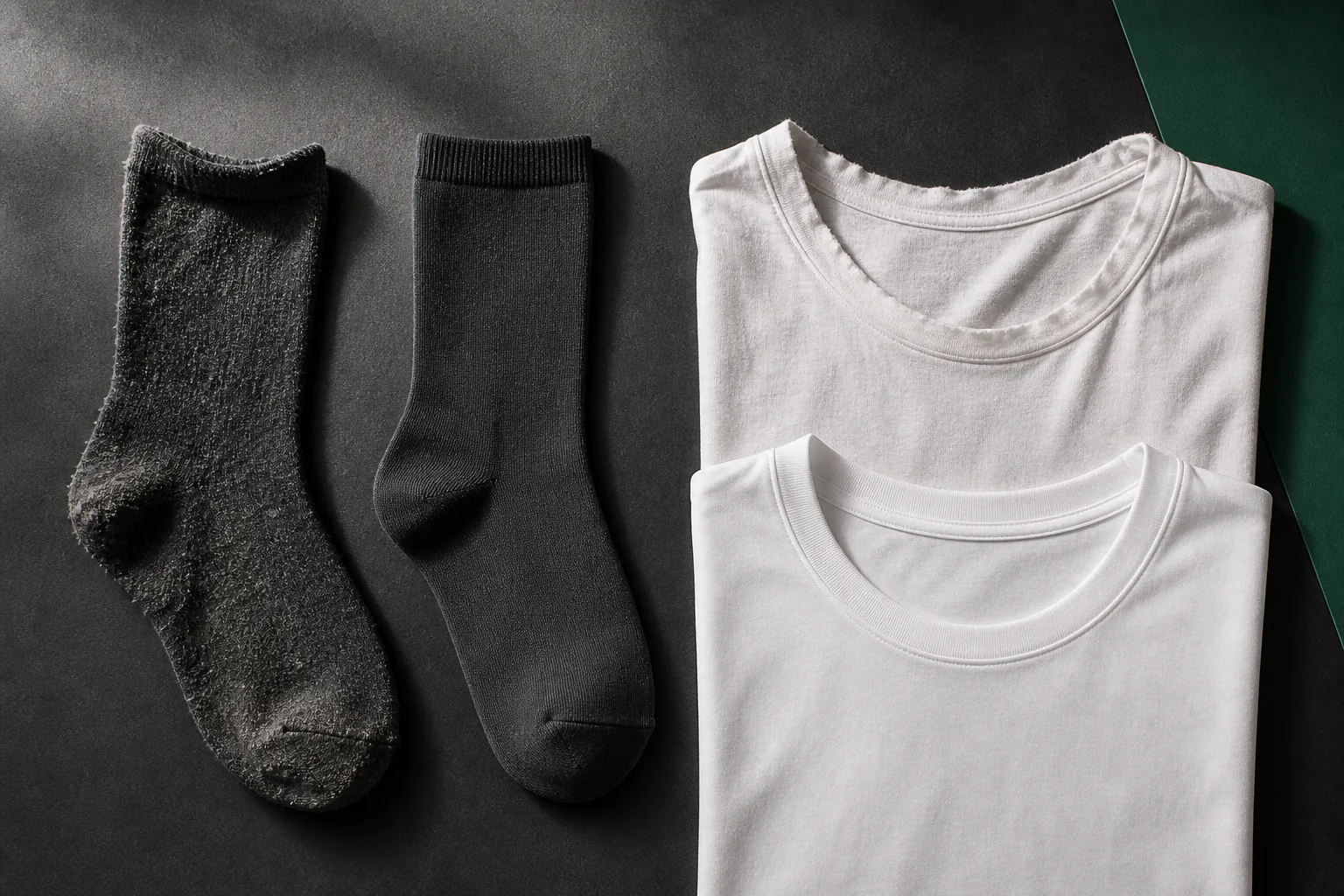
Socks take more friction than almost anything else you own, so they wear out first. A well-made pair in a rotation of eight to ten will typically hold up for six months to a year of regular wear before the heel thins or the cuff loses its grip.
Replace a pair when you see any of the following:
- A thin or shiny patch at the heel or ball of the foot, even without a visible hole
- A cuff that no longer holds its position above the ankle
- Pilling dense enough to feel rough against the shoe's lining
The fabric matters here too. See our full breakdown of dress socks vs. athletic socks for how material and cut affect lifespan by shoe type. If you're due for a refresh, we put one everyday sock through a two-week wear test to see how it held up against the usual multipack.
T-shirts: 1 to 2 years for anything worn weekly
A cotton tee in regular rotation starts to lose shape well before it develops a hole. The collar stretches out, the fabric goes thin enough to see skin through it under bright light, and the color fades from repeated washing. None of that is a hole, but all of it reads as "old" the moment someone's standing close enough to notice.
A tee worn once or twice a week can last two years. One worn as a daily undershirt is closer to a one-year cycle. If you're building or maintaining a small wardrobe, this is worth planning around rather than discovering. Our 20-piece capsule wardrobe guide treats tees as a category to refresh annually, not a one-time purchase. The fiber itself changes this math too: our merino wool vs. cotton breakdown covers which fabric holds up longer under regular washing.
Underwear: 6 to 12 months, no exceptions
This is the category men hold onto the longest and should replace the fastest. Elastic waistbands lose recovery well before the fabric shows damage, which means a pair can look intact while fitting and functioning worse than it did on day one. Once a waistband stops snapping back after a stretch, or the fabric has gone thin at the seams, it's done its job and it's time to move on.
A reasonable rule: replace on a rolling basis every six to twelve months, and don't wait for a visible hole as the signal. If you're stretching the same eight pairs across three years, you're wearing worn-out elastic, not worn-out cotton.
How many of each to actually own
Rotation size matters as much as replacement timing. Too few pairs and everything wears out at the same rate, forcing a full replacement all at once instead of a steady trickle.
- Socks: 8 to 10 pairs, enough to go roughly a week and a half between washes without repeating too often.
- T-shirts: 6 to 8 in regular rotation, split between undershirts and standalone tees.
- Underwear: 7 to 10 pairs, enough for a full week plus a buffer for laundry day slipping.
Buy in a staggered pattern rather than replacing the whole drawer at once. Adding two or three new pairs every few months keeps the rotation fresh without ever facing a total drawer replacement on the same week. The same staggered approach works across the rest of our accessories coverage, not just socks and tees.
What shortens the lifespan of all three
High heat is the main culprit. Hot water and high-heat drying break down elastic and cotton fibers faster than normal wear does. Washing in cold or warm water and air-drying or using a lower heat setting will meaningfully extend the life of socks, tees, and underwear alike, more than any specific brand choice will.
Fabric softener is worth skipping on all three categories as well. It coats fibers with a residue that reduces stretch recovery in elastic waistbands and cuts down on the breathability of moisture-wicking materials, which is the opposite of what you want from a tee you're wearing under a shirt all day.
Dryer heat also shrinks cotton over repeated cycles, which is part of why a tee that fit fine a year ago now feels shorter in the body. Air-drying on a line or rack costs a little more time and adds real months to a garment's useful life.
A simple system for tracking replacement
Most men don't need a spreadsheet for this, just a habit. Pick one day a season, the start of each new season works well, and do a five-minute check of all three drawers. Pull anything with a thinning heel, a stretched-out collar, or a waistband that no longer snaps back, and replace it in the same order it left. This keeps the drawer at a constant, working size instead of slowly filling with pairs that technically still fit but no longer do their job.
It also spreads the cost out. Replacing two or three worn pairs every few months is a smaller expense than discovering an entire drawer needs replacing at once, which is what happens when everything gets bought in the same batch and wears out on the same schedule.
Bottom Line
Socks, tees, and underwear all have a shorter useful life than most men assume, and the wear shows up as loss of function before it shows up as visible damage. Rotate in replacements on a rolling schedule instead of waiting for something to develop a hole, and wash on lower heat to stretch the interval between replacements.